Meme Strategy Ultimate Guide: Viral Mechanics, Brand Safety & Campaigns That Land (2026)
Most meme advice stops at "be funny and post often." That is craft, not strategy. This guide takes the systems view: the network mechanics that actually spread memes, the real tradeoff between brand-made and organic meme content, the structure of a meme marketing campaign you can brief and measure, and the brand safety line that decides when a meme gets pulled. Pair it with the sibling craft guide and you have both halves of the problem.
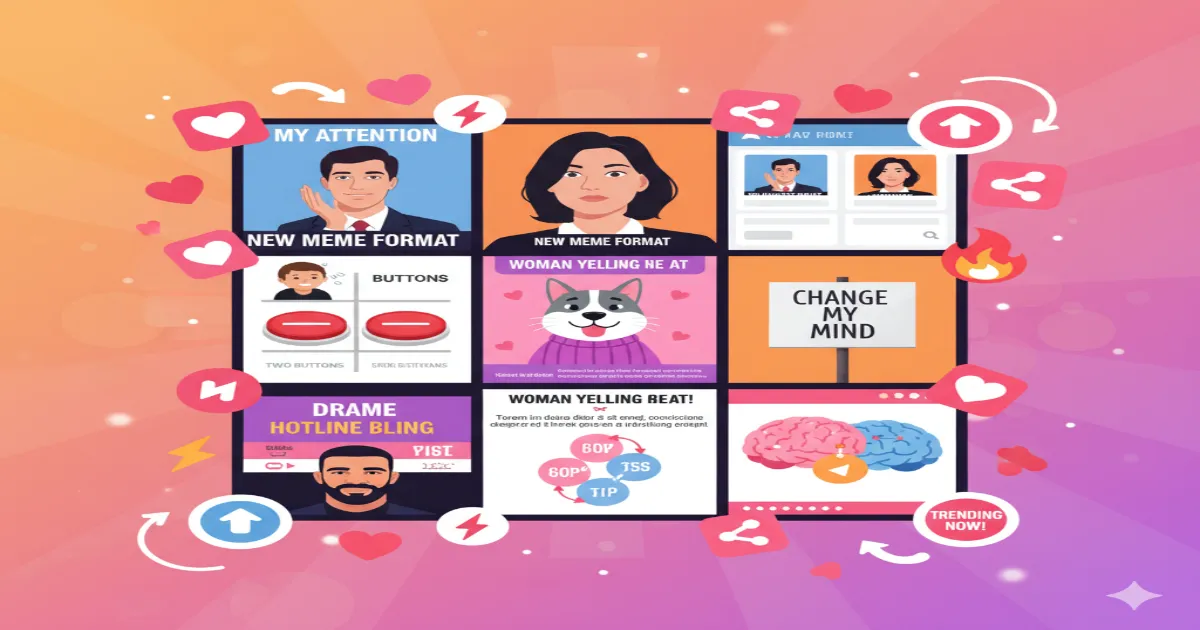
Why Memes Are a Strategy, Not a Stunt
A meme is not a joke a brand tells. It is a unit of culture that travels because it carries meaning an audience already shares. The strategy question is never "is this funny"; it is "will this be forwarded, and what does forwarding it say about the sender?" Those are different questions, and the answer to the second one decides whether you are doing meme marketing or just adding to the noise.
Three properties make memes useful as a marketing lever, and understanding each one is what separates a campaign that compounds from a campaign that flops:
- Network effect. Each share is also a distribution node. A meme that costs nothing to forward and rewards the forwarder with social credit spreads because forwarding it is rational self-interest, not charity to your brand.
- Low decode cost. A meme lands in under a second because the audience recognizes the template. Recognition does the heavy lifting; your text is the punchline on top of an existing setup.
- Identity signaling. Sharing a meme tells the sharer's audience something about the sharer. The most-shared memes let the sender look clever, in-group, or self-aware. If your meme makes the sender look like a marketing channel, they will not share it.
When all three levers are pulled, the meme behaves like a small piece of earned media with paid distribution economics — you pay to seed it, the audience carries it the rest of the way. When any one lever is missing, you have a branded joke, and branded jokes rarely travel. The meme generator makes the asset; this guide is about making the asset travel.
Brand Memes vs. Organic Memes: The Real Tradeoff
Brand-made memes and sponsored organic memes are not the same product. They have different cost structures, different risk profiles, and different ceilings. Picking between them is the first strategic decision in any meme program, and the wrong pick is the source of most "brand cringe" incidents.
When brand-made memes land
A brand-made meme works when three conditions hold: the brand has a lived voice the audience already recognizes, the joke is an inside one for people who already know the brand, and the meme is recognizably the brand's own rather than a borrowed template dressed up in brand colors. Wendy's sassy account persona, Duolingo's unhinged owl, and the NBA's on-trend playoff memes all share these properties — the brand is the joke's premise, not a logo slapped on someone else's punchline.
When those conditions do not hold, you get the cringe pattern: a brand account adopts a template that originated in a community it has no relationship with, fills it with marketing copy, and ships it. The audience recognizes the template, notices the mismatch, and reads the post as the brand trying too hard. The lesson is structural: brand memes work as extension of an existing voice, not as a way to acquire a voice you do not have.
When sponsoring organic creators wins
Sponsoring creators to make memes costs more per asset, but it solves two problems brand-made memes cannot. First, the creator's voice is the one the audience already trusts, so the meme carries that trust forward. Second, the joke belongs to the creator, which removes the brand from the punchline and lowers the cringe risk — even if the joke fails, the brand is the sponsor, not the comedian. For reach into communities you do not yet belong to, sponsorship is usually the higher expected-value play.
The tradeoff in one table:
| Property | Brand-made meme | Sponsored organic meme |
|---|---|---|
| Cost per asset | Low (in-house) | Higher (creator fee + management) |
| Voice risk | High — forced voice reads as cringe | Low — voice is the creator's |
| Audience fit | Best for in-group community | Best for cold reach |
| Attribution | Direct (branded account posts) | Indirect (sponsored tag + landing) |
| Volume ceiling | Low — brand can post sparingly | Higher — multiple creators in parallel |
The decision rule: use brand memes for in-group community moments where you are the premise; sponsor creators when you need reach into audiences that do not yet know you, and the joke is theirs. The brand safety question — when either type crosses a line — gets its own section below.
The Meme Marketing Campaign Structure
A meme campaign is not a content calendar with jokes. It is a brief, a concept, a format, a distribution plan, and a measurement plan — the same five parts as any other campaign, just tuned for the fact that the asset is more volatile and the attribution is harder. Skipping any of the five is how meme programs drift into "we tried it once, it didn't work."
1. Brief: the one-sentence objective
The brief states what the campaign is supposed to do in one sentence — not "go viral," which is an output, but something like "introduce the new pricing tier to developers on X and Reddit over four weeks, with earned reach as the leading indicator." If the brief names virality as the goal, the brief is wrong; virality is a mechanism that serves a goal.
2. Concept: the recognition trigger
Concept is the recognition trigger you are betting on. The most reliable triggers are existing templates the audience already knows, combined with a twist that maps the template to your topic. Reskinning the "two buttons" template with a real decision your audience faces is concept work. Inventing a brand-new visual format from scratch is concept risk — sometimes it pays off, but treat it like a research bet, not a campaign staple.
3. Format: where the joke lives
Format decides where the punchline sits: static image, animated GIF, short video, or text-first format like a screenshot of a fictional conversation. Each format has a different decay curve. Static image memes have the longest shelf life and the lowest production cost; video memes have the highest peak engagement but the shortest shelf life and the highest production cost. The GIF maker covers the animated middle ground that a lot of brands sleep on. Pick format from the campaign's distribution plan, not in isolation.
4. Distribution: seeding and amplification
Distribution is where most meme programs lose. A meme needs seeding (the first 50 to 500 shares that decide whether it catches) and amplification (paid boost if it does, organic surrender if it does not). Seeding from a brand account alone rarely works; seeding through partnered creators, in-group communities, and employees-as-advocates is what gives a meme its initial network push. Distribution strategy gets its own section below.
5. Measurement: leading and lagging indicators
Measurement has to be designed before launch, not retrofitted. Pick a leading indicator you can watch in the first 48 hours (share rate, save rate) and a lagging indicator that ties back to the brief (landing page visits, signups, branded search lift). The full measurement and attribution framework is in its own section below — the structural point here is that "we will look at engagement" is not a measurement plan.
# Five-part campaign brief template (paste into your doc)
objective:      one sentence, names audience + outcome, not "go viral"
concept:        template + twist; recognition trigger you are betting on
format:         static | gif | video | text-first; matches distribution channel
distribution:   seeding plan + amplification trigger + kill threshold
measurement:    leading indicator (48h) + lagging indicator (campaign-end)
Five parts, no shortcuts. A campaign with a great concept and no distribution plan is a brand telling a joke to itself; a campaign with great distribution and no measurement is a brand paying to learn nothing. The brief itself benefits from being documented rather than held in chat history — the habits in the documentation best practices guide apply as cleanly to campaign briefs as they do to engineering docs.
The Craft vs. Strategy Bridge
This guide is the strategy half of a two-part set. The craft half — how to actually compose a meme that is funny, how to choose and crop a template, how to set text rhythm and visual contrast — lives in the sibling meme generator entertainment guide. The two guides are intentionally split because the failure modes are different: bad strategy produces a campaign that does not move the needle; bad craft produces a meme nobody wants to forward even when the strategy is right.
The recommended reading order is strategy first (this guide), craft second (the sibling). Strategy tells you what to make and why; craft tells you how to make it well. A team that reads only the craft guide can produce great-looking memes that go nowhere; a team that reads only this guide can brief a campaign that nobody wants to execute. The full picture requires both halves.
The rest of this guide assumes the craft half is handled or delegated. When we say "build the asset," we mean "build it using the craft guide's composition rules." When we say "the meme has to be funny," we mean "apply the craft guide's humor mechanics." Strategy does not replace craft; it directs it. Brand color discipline — keeping brand palettes consistent across template reskins — is the layer beneath the craft guide and the color picker ultimate guide covers it.
Distribution Strategy: Per-Platform Memes
A meme is not platform-agnostic. The same asset that travels on X (text-forward, screenshot-friendly) can die on Instagram (image-grid layout, swipe competition) or on TikTok (video-first, sound-on). Distribution strategy means designing the meme for the platform, not adapting it after the fact.
X / Twitter
X rewards text-forward memes: screenshot jokes, fake conversations, remixes of templates that read as quickly as a tweet. Native images under 5 MB and short videos both travel; quote-tweet remixes are a distinct format unique to the platform. The platform's feed favors recency, so trend windows here are shorter than on most networks — a meme that worked on Monday can feel stale by Friday.
Instagram and Threads
Instagram is a visual grid first, so meme quality matters more than trend speed. Carousels outperform single images because each slide earns an additional impression. Threads inherits much of Instagram's audience but behaves more like X in feed mechanics, so the same meme often works in both with minor copy adjustments.
TikTok and Reels
Short-form video memes are their own category: they require sound, they require a hook in the first second, and they ride audio trends more than image trends. A static-image meme ported to TikTok will fail; a TikTok meme ported to a static image will usually also fail. The YouTube thumbnail and first-frame guide covers the parallel problem on long-form video and is worth reading for the cross-format thinking alone, and the sibling GIF maker animation guide covers the animated-format middle ground that bridges static and video memes.
Reddit and Discord
Community platforms are the strictest test of meme strategy. Reddit punishes anything that reads as marketing — even a great meme will be downvoted if the brand attribution is too obvious. The play here is community-first: post as a participant, not a brand, and treat any marketing uplift as a side effect rather than the goal. Discord servers behave similarly inside their channels.
LinkedIn memes are a 2026 genre of their own, and the failure modes are sharper than anywhere else. The audience is identity-aware and judges a post against the author's professional reputation. Work-appropriate inside jokes about the industry travel; forced humor from a brand page reads as cringe at a higher rate than on any other platform.
The cross-platform strategy is in the broader social media optimization content strategy guide, and the toolchain for managing all of these in one place is documented in the social media tools guide. Both are required reading alongside this section if you are running a multi-platform campaign.
Hashtag Strategy for Memes
Hashtags do two different jobs in a meme campaign, and conflating them is a common mistake. The first job is discoverability — making the meme findable by people searching the trend. The second job is attribution — making the meme traceable back to the campaign so you can measure earned volume. The same hashtag rarely does both well.
Discoverability hashtags
Discoverability hashtags are short, generic, and high-volume: the trend name, the template name, the topic. They get the post in front of searchers, but they also get it lost in the flood. Two to three is the practical ceiling; more than that and the post reads as keyword stuffing, which actively hurts on most 2026 ranking systems.
Attribution hashtags
Attribution hashtags are unique, branded, and low-volume. They are designed not to be searched but to be counted: a hashtag nobody else uses lets you measure how many organic reposts and remixes your campaign generated, even when the reposts do not link to you. This is the closest thing memes have to a tracking pixel.
The pattern is one attribution hashtag plus two to three discoverability hashtags, with the attribution hashtag shown in the asset itself (so remixers keep it) and the discoverability hashtags in the caption only. The full mechanics — character budgets, banned-tag lists, per-platform caps — are documented in the hashtag generator social media guide, and the hashtag generator tool handles the per-platform formatting if you do not want to maintain those rules by hand. Caption length is its own constraint on most platforms; the character counter and word counter measure it in real time, and the character counter strategies guide covers the longer-form length-budget logic that applies to captions as much as it applies to headlines.
# Hashtag pattern for a meme campaign
caption:   [joke] [trend name] [broad topic]   # discoverability: 2-3 max
asset:     #BrandCampaignName                   # attribution: 1, baked into the image
Thumbnail and First-Frame Thinking
Memes increasingly live inside video feeds, which means the first frame is doing the work a thumbnail used to do. A static meme that worked as a standalone image often needs a redesigned first frame when ported to a video format — not because the joke changed, but because the audience now decides whether to keep watching in under a second, and a frame that reads as "branded content" gets swiped past.
Three principles carry over from long-form video to meme video. First, the first frame has to communicate the joke's setup, not its punchline; the punchline is what the second and third frames are for. Second, text on the first frame has to be legible at feed-scrolling speed, which means larger type and fewer words than you would use on a static post. Third, the first frame is what the platform shows in search and what gets screenshotted, so it has to work as a still image even though the asset is video.
If you are sourcing first frames from existing video, the YouTube thumbnail downloader guide covers the technical workflow for pulling reference frames you can study, and the broader craft of designing thumbnails that work at feed speed is the same skill whether the asset is a video meme or a ten-minute video. When the first frame becomes a still asset you ship separately, the export pipeline in optimizing images for web keeps it light enough to load at feed-scrolling speed, and image to base64 is the right path when the frame needs to be inlined rather than hosted. Memes that need to live in both image and video formats should be designed as two assets from the start, not as one asset adapted to the other.
The QR Bridge: Online Memes, Offline Activation
Memes are an online format, but the campaign that produced them often has an offline component — a sticker pack, a printed flyer, an event activation, packaging. The bridge between the offline asset and the online campaign is a QR code, and it is the most underused distribution lever in meme marketing.
The mechanics are simple: every physical asset carries a QR code that points to a dedicated campaign landing page, and the landing page is where the audience gets the digital version of the meme to share. This does two things at once. It measures offline-to-online conversion in a way last-click attribution cannot (the scan is the conversion event), and it gives the offline audience a one-tap way to forward the meme, which is what memes need to do their work.
The QR code itself has to be designed for the surface it lives on. A sticker on a laptop has different size and contrast requirements than a printed poster, and a QR code on packaging has to scan through the packaging film. The full mechanics — minimum size, quiet zone, error-correction level, color contrast — are documented in the QR code generator ultimate guide, and the QR code generator tool produces codes that match those specs. The strategic point is that the QR bridge belongs in the campaign plan from day one, not as an afterthought.
Measurement and Attribution: Honest About the Hard Parts
Meme measurement has to start with an honest admission: last-click attribution systematically undercounts memes. People screenshot memes, copy them into other apps, forward them in private messages, and remix them with the brand removed. None of that is tracked by any pixel. If your measurement plan assumes the meme is only doing work when someone clicks a tracked link, you will conclude memes do not work even when they do.
The metrics that actually matter
Three metrics do meaningful work for meme campaigns, and they are all rate-based rather than absolute:
- Share rate — shares per thousand impressions. This is the leading indicator of network effect; if it is climbing in the first 48 hours, the meme is compounding, and if it is flat or falling, you are paying for reach you should be earning.
- Save rate — saves per thousand impressions. Saves are quieter than shares and often more diagnostic: a high save rate with a low share rate means the meme resonated but did not feel forwardable, which is usually a craft problem (too niche, too inside, too brand-specific).
- Earned reach ratio — earned impressions divided by paid impressions. A ratio above 1.0 means the audience is doing more distribution than your spend is; a ratio below 0.5 means you are buying distribution the network is not picking up.
Attribution techniques that help
Three attribution techniques narrow the gap, in roughly increasing order of effort:
- Branded short links with custom UTM parameters for each placement — works only when the meme includes a clickable link, which most do not.
- Branded attribution hashtags baked into the asset itself — counts organic remixes and reposts you would otherwise miss, as long as the hashtag survives remixes.
- Self-reported lift surveys — ask a sample of new signups how they heard about you; memes show up as "saw a post" or "friend sent a meme" far more than tracking pixels suggest.
None of these is a single source of truth. The honest practice is to triangulate: if share rate, branded hashtag volume, and self-reported lift all move together, you have a real signal; if only one moves, you have a measurement artifact. The arithmetic in the worked example below is illustrative — verify against your own audience before treating any of these numbers as targets.
# Worked example, illustrative only — not a benchmark
paid_impressions   = 100_000
earned_impressions = 140_000   # reported by the platform's earned-reach dashboard
shares             = 1_200
saves              = 900

share_rate         = shares / paid_impressions * 1000   # = 12.0 per 1k
save_rate          = saves  / paid_impressions * 1000   # = 9.0 per 1k
earned_reach_ratio = earned_impressions / paid_impressions  # = 1.40

# A ratio above 1.0 means the network is amplifying spend.
# Treat all five numbers as illustrative; your baseline is what matters.
The broader content measurement framework — including how to set baselines and how to read leading vs. lagging indicators across an entire content program — is in the social media optimization content strategy guide. This section is the meme-specific overlay on top of that framework. The arithmetic of share rate, save rate, and earned reach ratio is straightforward — the percentage calculator handles the per-thousand math so you do not have to do it by hand.
Brand Safety and the Line
Memes are a higher-risk content format than most of what a brand publishes. The reason is structural: humor that lands usually has an edge, and edges cut. A meme that is funny to one audience can be offensive to another, and the same template can mean different things in different communities. Brand safety for memes is not about avoiding risk; it is about deciding where the line is before you cross it, and having a process for pulling back fast when you do.
Where the line actually is
The line is not a single rule; it is a set of decisions a brand has to make in advance. Three questions, asked before launch, prevent most incidents:
- Who is the butt of the joke? If the joke is at the expense of a group the brand is not part of, do not ship it. Poking fun at your own industry, your own customers' shared pain, or your own brand is usually fine; poking fun at a marginalized group, a competitor's employees as people, or a real individual is not.
- Does the template's origin matter? Some templates originated in grief, trauma, or political contexts that the brand may not want to be associated with, even years later. A five-minute search for the template's origin is cheap insurance.
- What changes the meaning if context shifts? A meme that is fine today can become toxic if a real-world event makes its joke land differently tomorrow. Have a kill process ready before you need it, not after.
Cultural sensitivity and appropriation
A meme that borrows from a culture the brand is not part of — using AAVE in a brand voice that has not earned it, borrowing visual styles from a community the brand has no relationship with, remixing religious or cultural symbols — is appropriation risk, and the audience reads it as such. The test is not whether anyone complains; it is whether the brand would be comfortable explaining the meme's source to a member of the originating community. If the answer is no, do not ship.
The pull process
Having a pull process is more important than never making a mistake. A brand that pulls a meme within hours of community feedback is doing brand safety work; a brand that leaves a misfired meme up for a week is making the problem worse. The pull process is three steps: monitor for feedback in the first 24 hours, escalate any post that draws sustained negative response to a decision-maker within 4 hours, and pull (do not edit) the post once the decision is made. Editing a misfired meme reads as covering up; pulling it reads as accountability.
The brand safety decisions in this section intersect with the legal questions in the next section, but they are not the same problem. Legal risk is about what you can be sued for; brand safety is about what you can be trusted with. A meme can be entirely legal and still brand-unsafe, and the reverse is rarer but possible.
Legal and Copyright: What You Can and Cannot Use
Meme copyright is genuinely messy, and any guide that pretends otherwise is wrong. The honest framing: most popular meme templates occupy a gray zone where informal community norms have outpaced formal licensing, and adding a brand or a paid placement to a template changes the legal calculus in ways the original template's creator may not have agreed to.
The four practical rules
- Verify the underlying image rights. The image inside the template has an origin, and that origin has a rights holder. Royalty-free stock photography, your own original photography, and explicit Creative Commons licenses are safe. Screenshots of films, TV, and copyrighted artwork are not, even when the community treats them as fair game.
- Avoid living people whose likeness you have not licensed. A person's face is their likeness, and using it for commercial promotion without a release is a claim waiting to happen. This is the rule that kills the most "but everyone uses this template" ideas.
- Avoid copyrighted characters. Cartoon characters, video game sprites, and branded mascots belong to someone. Parody defenses exist but are narrow and expensive to litigate; do not rely on them for a campaign.
- Prefer templates built from your own original photography. The cleanest meme programs build templates from photography they own. Higher production cost, dramatically lower legal risk, and the bonus of uniqueness in a feed full of recycled templates.
Fair use, and why you should not lean on it
Fair use is a real doctrine and a real defense, but it is a defense you raise in court after you have been sued, not a shield you wave at a cease-and-desist. For commercial marketing, fair use claims are weaker than for commentary or news, and the cost of litigating a fair use case — even a winning one — is more than the cost of shooting your own template. Use fair use as a backup, not as a plan.
The full mechanics of copyright, licensing, and takedown are documented in the copyright protection guide, and the developer-side legal landscape (which matters when your meme program includes a custom-built generator or user-uploaded content) is in the legal guide for developers. Both are required reading for anyone running a meme program at scale; this section is the strategy overlay, not a substitute for either.
Trend Prediction vs. Trend Riding
There are two strategic postures in meme marketing, and most brands pick the wrong one. Trend riding is participating in a meme that is already spreading, with the goal of joining the conversation. Trend prediction is making a meme you expect to spread, with the goal of starting the conversation. They look similar from the outside but have completely different economics.
Trend riding: low variance, low ceiling
Trend riding is the safe play. You take a template that is already spreading, add your twist, and post it while the trend is still warm. The recognition trigger is free (the audience already knows the template), the production cost is low, and the worst case is the post flops and you move on. The ceiling is also low: you are one of many brands doing the same thing, and the audience has already seen the joke a hundred times. Trend riding is a content calendar tactic, not a campaign pillar.
Trend prediction: high variance, high ceiling
Trend prediction is the risky play. You build an original meme you expect to spread, seed it, and hope the network picks it up. The recognition trigger does not exist yet — you have to create it. The production cost is higher because original work is harder than reskinning a template. The ceiling is also much higher: a meme that catches becomes the trend everyone else rides, and the brand that started it owns the association.
When to start, when to retire
The start decision is about timing. For trend riding, the window is the first 48 to 72 hours of a trend's life; after that, you are noise. For trend prediction, the start decision is about confidence: only bet on a predicted trend when you have at least three independent signals (community chatter, format hunger, prior analogous successes) that the audience is ready for it.
The retire decision is about lifecycle. A meme template's productive life ends when engagement on new posts using it drops below your baseline for two consecutive cycles, or when the template's context shifts in a way that makes your reuse read as tone-deaf. Templates can also be killed by association — if the template gets picked up by a community or movement your brand does not want to be next to, retire it immediately even if engagement is still high. The arithmetic in the worked example is illustrative — your baselines will differ.
# Lifecycle signals, illustrative
# A trend-riding meme is worth posting if trend_age < 72h
# A predicted meme needs 3+ signals before you bet
# A template retires when engagement < baseline for 2 cycles
# A template is killed immediately if context shifts under it

trend_age_hours  = 60   # within the ride window
signals_count    = 4    # above the prediction threshold
engagement_ratio = 0.4  # below baseline → retire
The honest takeaway: most brands should trend-ride more and trend-predict less, because the prediction hit rate is low even for specialists. Reserve trend prediction for moments where the brand has unique standing to make the joke — an industry inside, a community the brand actually belongs to, a moment where the brand is the punchline and benefits from owning it. Tracking template age and time-to-retire is mechanical calendar work; the age calculator and date difference calculator handle it without a spreadsheet.
7 Common Meme Strategy Mistakes
- Forcing brand voice onto a community template. The template's voice is the community's, not yours. If your version reads as "brand wearing a costume," the audience will not share it. Fix: only use templates whose voice you can credibly inhabit, or sponsor the community to make the meme in their voice.
- Skipping attribution design. A campaign without a branded attribution hashtag baked into the asset cannot be measured for earned reach, which is the metric that matters most. Fix: design the hashtag into the asset from the first draft, not as a caption afterthought.
- Treating virality as the goal. Virality is a mechanism, not an outcome. A campaign that goes viral but does not move the lagging indicator in the brief is a campaign that wasted its moment. Fix: tie every meme brief to a business outcome, not a reach number.
- No kill process. A misfired meme left up for a week is a brand safety incident; the same meme pulled in four hours is a near miss. Fix: name a decision-maker and a pull threshold before launch, and rehearse the pull once a quarter.
- Cultural appropriation as "borrowing." Using a community's language, visual style, or symbols without belonging to that community reads as theft to the community and as cringe to everyone else. Fix: when in doubt, ask a member of the originating community before shipping, and accept "no" as an answer.
- Ignoring platform decay. A meme that worked on X on Monday can be dead by Friday, and the same meme ported to TikTok without redesign usually dies on arrival. Fix: design per-platform from the start, and treat trend age as a hard constraint, not a guideline.
- Measuring last-click only. Memes do most of their work off the tracked-link graph — in screenshots, private forwards, and remixes. A measurement plan that only counts clicks will conclude memes do not work even when they are doing the heaviest lifting in the campaign. Fix: triangulate share rate, branded hashtag volume, and self-reported lift, and treat last-click as a floor, not a ceiling.
Each of these is a strategic mistake, not a craft one. The craft mistakes — bad composition, weak text, wrong template — are catalogued in the sibling meme generator entertainment guide. The seven here are the strategy failures that no amount of craft can rescue.
Frequently Asked Questions
Related Articles
Meme Generator Entertainment Guide
The craft sibling: template selection, text composition, image cropping, and the visual humor mechanics that make a single meme funny.
Social Media Optimization Content Strategy
The cross-platform content strategy this guide overlays on: distribution, baselines, and leading vs. lagging indicators.
Social Media Tools Guide
The toolchain for managing multi-platform meme distribution from a single workflow without losing per-platform specificity.
Hashtag Generator Social Media Guide
Discoverability vs. attribution hashtags, per-platform caps, and the formatting rules this guide's hashtag strategy depends on.
YouTube Thumbnail Downloader Guide
First-frame and thumbnail craft for video-format memes — the cross-format thinking this guide's distribution section builds on.
QR Code Generator Ultimate Guide
The QR bridge from offline activation to online campaign — measurement of offline-to-online conversion that last-click cannot see.
Conclusion: Memes as a System, Not a Stunt
Meme strategy is a real discipline, and it is distinguishable from meme craft in the same way content strategy is distinguishable from copywriting. The strategy decides what to make, why to make it, where it goes, how it is measured, and when it gets pulled. The craft decides how to make it well. This guide has covered the strategy half: the network mechanics that spread memes, the brand-vs-organic tradeoff, the five-part campaign structure, per-platform distribution, hashtag roles, the QR bridge for offline activation, the honest limits of attribution, the brand safety line, the legal gray zone, the trend-riding vs. trend-prediction decision, and the seven strategic mistakes that no craft can rescue.
When you are ready to move from strategy to execution, open the meme generator for the asset, read the sibling meme generator entertainment guide for the craft, and use the QR code generator and hashtag generator for the distribution and measurement scaffolding. More guides on content strategy, social media, and creator workflows are catalogued on the NoCostTools blog, the broader toolchain is in the productivity tools ultimate guide, and the about page and the FAQ cover the editorial process and common questions behind these guides.