Meme Generator Entertainment Guide: Craft, Templates & Timing (2026)
Most meme guides stop at "be funny." This one covers the craft mechanics: the image-plus-text overlay that defines the medium, the difference between top/bottom, reaction, split-panel, and GIF formats, the template economy with attribution, watermark ethics, and the lifecycle timing of when to post and when to retire a format. The angle here is craft and entertainment, not strategy — for the broader content and audience playbook see our meme generator strategy guide.
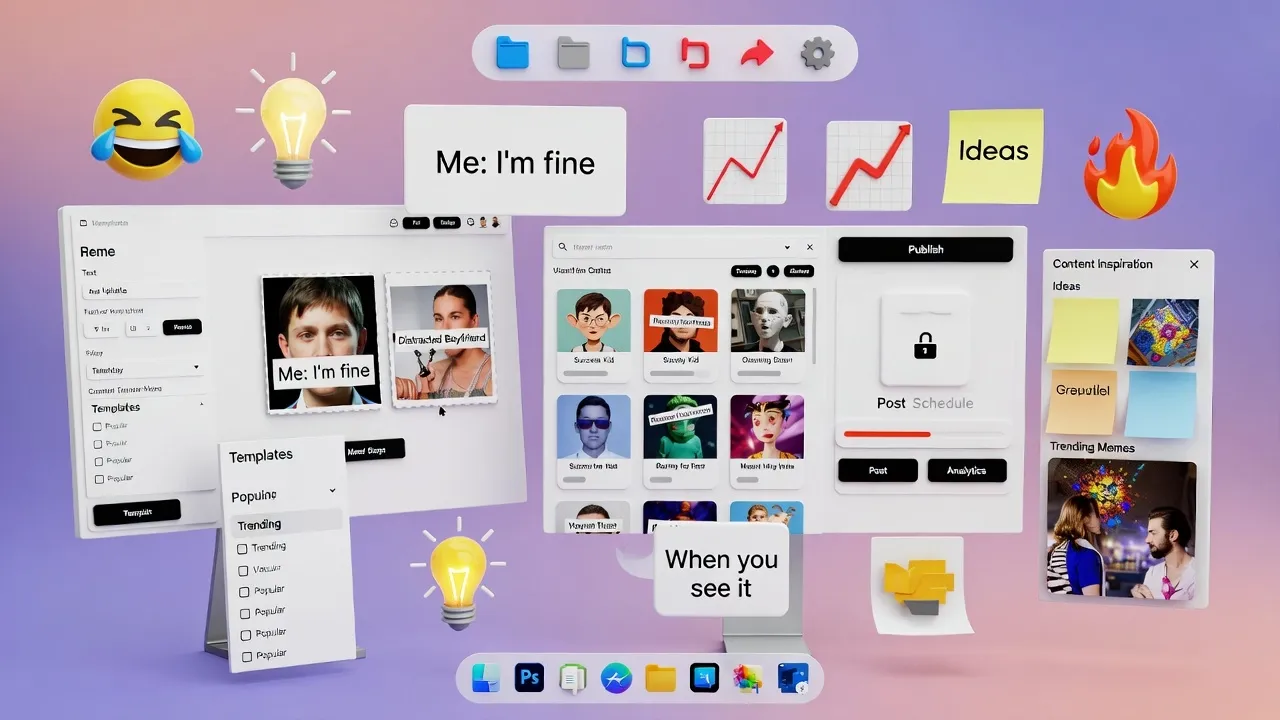
What a Meme Actually Is (and Isn't)
A meme, in the Richard Dawkins sense that the internet borrowed, is a unit of culture that reproduces by imitation. That definition matters for entertainment creators because it tells you exactly what you are making: not a joke, not a graphic, not a "post" — a replicable pattern. The classic image macro works because anyone can substitute their own text into the template and the audience immediately recognizes the format. The setup and the visual grammar do half the work; your caption does the other half.
This guide treats entertainment memes specifically. Political memes, propaganda memes, and brand-response memes follow different rules about reach, harm, and taste — they are out of scope here. The entertainment meme is the one whose only job is to make a friend, a follower, or a stranger laugh, nod, or share. The craft decisions below all serve that one job.
Three properties of a healthy entertainment meme
- Recognizability. The audience knows the format within a glance. Novelty belongs in the caption, not in the visual grammar.
- Composability. Someone else can take the format, swap the text, and produce a new meme in under two minutes. If the format cannot be remixed, it is a single cartoon, not a meme.
- Decay. Every meme format has a half-life. The template that kills today reads as "trying too hard" in three weeks. Lifecycle timing is a craft skill, not a marketing tactic.
Those three properties are why meme craft is its own discipline, separate from social media tooling generally and from broader content strategy. Tools help; understanding the medium makes the tools worth opening.
Format Mechanics: Top/Bottom, Reaction, Split-Panel, GIF
Every entertainment meme is built from one of four format primitives. Choosing the wrong one for the joke is the most common craft mistake — and the easiest to fix once you can name them.
1. Top/bottom text overlay (the classic image macro)
The format that defined the medium. A single static image with white Impact-style text in a black stroke, top line as setup, bottom line as punchline. The image does the framing — facial expression, absurd juxtaposition, recognizable character — and the two text zones do the joke. The format works because the audience decodes it in under a second: top line registers as "context," bottom line registers as "subversion," laugh happens.
Two craft rules. Keep each line to two or three lines of wrap at roughly 25 to 35 characters per line, which yields 50 to 105 characters per zone — enough for a setup and a punchline, not enough to ramble. And keep the text inside the image margins; letting Impact letters touch the image edge reads as "broken template," not as deliberate cropping.
2. Reaction meme (single panel, no overlay text)
A single image — a screenshot, a still from a video, a candid photo — used to express an emotion in reply to something. The caption lives in the post body, not on the image. Reaction memes work because they are relational: the audience decodes them as "this is how I feel about X" rather than as a self-contained joke. They travel better than image macros because they require no text overlay to be reposted, and they survive translation across languages far better than top/bottom puns do.
3. Split-panel / two-panel (expectation vs reality)
Two images stacked or side by side. Top panel sets up an expectation, bottom panel delivers a subversion. Common variants: "what I expected / what I got," "me / also me," "POV / reality." The craft rule is timing: the audience needs to read the top panel fully before their eye drops to the bottom. If the top panel is text-heavy or busy, the joke collapses. The bottom panel is where the laugh actually lands, and it deserves the visual weight.
4. GIF meme (the motion meme)
A short looping GIF used the same way a reaction meme is used, except the motion is the joke. GIF memes excel at emotions that need duration to register — an eye roll, a double take, a slow build of horror. They are heavier files than static panels, so they live in feeds that tolerate them well (Tumblr, Discord, Slack, Threads) and they suffer in feeds that compress aggressively. Our GIF maker and the deeper GIF animation guide cover the production side; the craft decision is when motion earns its byte cost. Static does the job? Stay static.
/* CSS shorthand for a classic top/bottom text overlay.
   The stroke is the part that makes it legible over any photo. */
.meme-overlay {
  font-family: Impact, "Anton", "Arial Black", sans-serif;
  text-transform: uppercase;
  color: #ffffff;
  font-size: 3.5rem;            /* ~7% of a 1080px-tall image */
  line-height: 1.05;
  letter-spacing: 1px;
  text-align: center;
  /* 4-direction black stroke: ~8-12% of font-size for legibility */
  text-shadow:
    -2px -2px 0 #000,  2px -2px 0 #000,
    -2px  2px 0 #000,  2px  2px 0 #000;
}
The stroke is the load-bearing part of the recipe. Impact itself is just a heavy condensed sans; what makes the genre visually distinct is the white-fill-plus-black-stroke combo, which stays readable over a white sky, a black shadow, a busy screenshot, or a gradient. Swap Impact for Anton or Arial Black and the meme still reads as a meme; drop the stroke and it stops reading as one.
The Template Economy (and Attribution)
A meme template is a reusable image macro format with a recognizable structure and an established set of caption slots. The template economy is the social agreement that templates circulate, get remixed, and evolve — but that the original creator of a specific template deserves credit when their identity is known. Treating templates as raw material with no provenance is the fastest way to poison your relationship with the communities that make them.
What counts as a template
- A named image macro — "Distracted Boyfriend," "Drake Hotline Bling," "Expanding Brain." Each has a recognizable image and an established caption pattern.
- A reaction panel — a screenshot of a specific character's expression that everyone agrees is "the reaction for X." The image and the emotion are inseparable.
- A two-panel contrast — the same image pair everyone uses for "expectation / reality" or "me / also me" jokes.
- A GIF loop — a specific clip that has become shorthand for an emotion (eye roll, slow clap, face palm).
Attribution is a craft decision, not a legal one
Most meme templates circulate under fair-use norms rather than clear licenses, so attribution is rarely legally required. It is, however, the line between a creator the meme community respects and a creator the meme community screens out. When the source of a template is a known tweet, video, or post, naming the source costs you one line of caption and earns you real goodwill — plus it lets the audience find more work from that creator. When the source is genuinely unknowable, saying so plainly ("template source unknown — DM if you know the origin") is better than claiming the format as your own.
The deeper questions of copyright, fair use, and what you can and cannot do with someone else's footage are out of scope here. Our copyright protection guide covers the legal framework, and the legal guide for developers addresses it from a contracts-and-licensing angle. For entertainment meme craft, the working rule is simple: credit when you can, never strip watermarks, never claim authorship of a format you did not create.
Text and Typography for Memes
Impact is not the only meme font, but it is the one the medium has standardized on, and there are mechanical reasons why. Knowing those reasons lets you break the convention on purpose instead of by accident.
Why Impact specifically
Impact is a heavy condensed sans-serif designed in 1965 for posters that had to be readable from a distance. The vertical compression packs many letters into a short line, which matters when your text zone is a thin strip above an image. The face ships free with every Windows install, which meant every early image-macro generator could rely on it being available, and the audience now reads the typeface itself as a meme signal — the same way a serif headline reads as news. Using Impact tells the audience "this is a meme" before they decode a single word.
The stroke matters more than the face
Drop the black stroke and Impact becomes a thin white sans that vanishes against bright photo regions. The stroke is what makes the format legible over any background — bright sky, dark shadow, gradient, busy screenshot. A reasonable rule of thumb is that the stroke should be roughly 8 to 12 percent of the font-size. On a 48-pixel font, that is a 4- to 6-pixel stroke (8.3 to 12.5 percent). On a 64-pixel font, that is a 5- to 8-pixel stroke. Go thinner and the text gets eaten by busy backgrounds; go thicker and the letters start to read as outlined shapes rather than words.
All-caps and line-breaking
All-caps is part of the convention, not a stylistic flourish. Lowercase Impact letters have descenders and varied heights that break the clean rectangular feel the audience expects. Line breaks are where craft actually lives: each text zone should hold two to three lines, roughly 25 to 35 characters per line. More than that and the joke reads as a paragraph; fewer than that and the format reads as under-baked. Break at natural breath points — at commas, at em-dashes, at the strongest word in the setup — never mid-word.
/* Stroke widths that match common meme font-sizes.
   The ratio stays near 10% of font-size across all three. */
.meme-text-sm { font-size: 2.25rem; text-shadow: -3px -3px 0 #000, 3px -3px 0 #000, -3px 3px 0 #000, 3px 3px 0 #000; }   /* 3px on 36px = 8.3%  */
.meme-text-md { font-size: 3.0rem; text-shadow: -4px -4px 0 #000, 4px -4px 0 #000, -4px 4px 0 #000, 4px 4px 0 #000; }   /* 4px on 48px = 8.3%  */
.meme-text-lg { font-size: 4.0rem; text-shadow: -5px -5px 0 #000, 5px -5px 0 #000, -5px 5px 0 #000, 5px 5px 0 #000; }   /* 5px on 64px = 7.8%  */
When to abandon Impact entirely
Two legitimate cases. First, when the meme is a parody of a specific brand or publication whose typography is itself the joke — using that brand's actual font family is funnier than using Impact. Second, when the meme is a GIF or a reaction panel that does not carry text on the image at all. Outside those two cases, abandon Impact deliberately or not at all; using a different sans because you "wanted something cleaner" is usually a sign the joke was not strong enough to deserve a meme in the first place. Counting characters while you draft is the fastest way to keep typography honest — the character counter and word counter do exactly that, and the reading time calculator is a useful sanity check on whether your caption will outstay its welcome.
Watermark Ethics: Don't Strip What Isn't Yours
A watermark is a visible attribution baked into the corner of an image — usually a creator handle, a channel name, or a logo. The watermark ethics of meme craft are simple, even if the legal situation is not.
The working rule
Do not strip watermarks from images you did not create. This includes watermarks on templates you remix, watermarks on stock-style reaction images you crop, and watermarks on GIF loops you trim down. If you cannot accept the watermark in the final meme, do not use the image — find a different source, or pay for a license that lets you remove it.
Why this is a craft rule, not just a moral one
- Audiences read stripped watermarks as theft. A visible blur, crop, or paste-over reads as "this creator took someone else's work and tried to hide it." Even if your use would otherwise be fair, the strip itself is what the audience punishes.
- Source footage is traceable. Reverse image search is one click. The original creator and their audience will find the strip, and the call-out will travel further than the meme did.
- Watermarks are recoverable credit. A watermark you keep is free attribution to a creator whose work made your joke possible. That is the relationship you want with the meme community.
When watermarking your own work is appropriate
Adding your own watermark to a meme you made from a public-domain or clearly-licensed source is reasonable and expected — it lets the meme travel back to you. The mistake to avoid is watermarking memes you built on someone else's template without crediting that template's creator. Your watermark on a "Distracted Boyfriend" remix that does not also name the original photo is claiming more authorship than you actually have. The honest pattern is: your watermark on your caption work, a caption-line credit for the template source. Cross-reference the copyright protection guide for what watermarking can and cannot do legally, and the broader content-ethics framing in our meme strategy guide when you are building a series rather than a one-off.
Meme Lifecycle Timing: When to Post, When to Retire
Every meme format has a half-life, and posting outside that window is a craft failure even if the joke itself is good. Lifecycle timing is platform-specific because engagement windows are platform-specific.
Platform engagement windows
- Twitter / X. Peak engagement lives in the first 18 to 60 minutes after posting. A meme tied to a trending event has a useful window of hours, not days. After 24 hours the algorithm has largely moved on regardless of quality.
- Reddit. Front-page reach happens in the first 12 to 24 hours. A meme that does not clear the rising queue in its first two hours usually does not break out.
- Instagram feed. The 8- to 24-hour window after posting is when the algorithm decides whether to push the post beyond your existing followers. Memes tied to a trend need to land inside that window.
- Instagram Reels / TikTok / YouTube Shorts. 24 to 72 hours is the realistic discovery window. Short-form video memes can compound for a week if the format is still active, but the peak is still inside the first three days.
- Facebook pages. 24 hours, with a long tail that rarely revives. Facebook memes travel in shares, not in feed discovery, so the format has to be relatable to people who will not have seen the original trend.
Format half-life vs. caption half-life
The two are different. A format (Distracted Boyfriend, for example) can keep cycling through new captions for months. A specific caption pattern — a particular pun construction, a particular phrasing — typically saturates in days. The craft discipline is to retire the caption pattern before the audience does, and to retire the format before the format itself becomes the joke ("oh look, another one of those"). The honest signal that a format is dying is not the calendar; it is when the captions you write for it start requiring more effort than the laugh they earn. Retire before the audience starts pity-laughing.
Trending templates vs. event memes
Trending templates tied to a specific event typically peak within 24 to 72 hours and read as dated within 5 to 10 days. Event memes are the most lifecycle-sensitive format in the medium. If you cannot post inside the first 24 hours of an event, the format is probably no longer worth posting. Our hashtag guide covers the discovery-side of trending windows; the craft decision here is just knowing the calendar your meme is on.
Originality vs. Trend: The Format Tradeoff
There are two ways to win with entertainment memes, and they pull in opposite directions. The trend path rides an active format: high reach, low originality, short half-life. The original path builds a new format from a reaction panel or an original image: low reach, high originality, longer half-life. Neither is better; the craft discipline is knowing which one you are making.
Trend path
- Reach. The format is already circulating, so audiences decode it instantly and the algorithm is more likely to surface it.
- Cost. The template does half the work, so the caption can be lighter.
- Risk. You are competing with everyone else using the same template; the bar for "the best version" is high and rising.
- Window. Days, sometimes hours. Miss the window and the format reads as dated.
Original path
- Reach. Slower. The audience has to learn the format, and the algorithm has no prior signal to push it.
- Cost. You are doing all of the work; the image, the framing, and the caption pattern all need to land.
- Risk. Lower competition, but the failure mode is "this is just a cartoon, not a meme" — the format is not replicable enough to spread.
- Window. Weeks or months. If the format catches, it catches slowly and lasts.
The honest craft move is to build a pipeline of both. Trend memes keep your channel alive in the short term; original formats are what actually grow a recognizable voice. The pipeline connects to broader content workflows in our social media content strategy guide and the channel-level tooling in the social media tools guide; this article stays on the per-meme craft decisions.
The Workflow: From Idea to Posted Meme
A meme workflow that respects the craft rules above takes about five steps. The free meme generator handles the production side; the workflow is what you do around it.
Step 1 — Identify the format
Decide which of the four formats the joke needs. Top/bottom text for setup-and-punchline. Reaction panel for a single emotion. Split-panel for expectation-versus-reality. GIF loop for a motion-dependent emotion. Mismatched format is the most common craft failure.
Step 2 — Source the image honestly
Use a public-domain image, a clearly-licensed stock image, a screenshot from your own work, or a known template you are willing to credit. Do not strip a watermark to get a clean source. If the source is a creator you can name, note the name in your caption. The image cropper and image resizer handle the dimension prep; the image compressor keeps the file small enough for feeds that punish heavy uploads, and the image-to-base64 converter is useful when you need to embed the source inline for testing.
Step 3 — Draft the caption
Write the caption in plain text first. Count characters; aim for 25 to 35 characters per line and 2 to 3 lines per zone for top/bottom formats. The character counter and text case converter are faster than fixing this after the fact.
Step 4 — Compose in the generator
Open the meme generator, load the source, drop the caption into the right zones, set Impact (or your deliberate alternative), apply the stroke, and export. The GIF maker is the equivalent step for motion memes; social media post generator helps with the caption body that travels with the image.
Step 5 — Verify before posting
Before you post: read the caption out loud, confirm the stroke holds against the lightest and darkest parts of the image, confirm the format is still active, confirm you have credited the source if applicable, and write alt text for accessibility. The alt-text step is covered in detail below; the rest is the craft checklist this guide is built around.
/* One-pass export pattern that respects every craft rule above.
   Drop into your generator's CSS panel or stylesheet. */
.meme-export {
  font-family: Impact, "Anton", "Arial Black", sans-serif;
  text-transform: uppercase;
  color: #ffffff;
  font-size: 3.5rem;
  line-height: 1.05;
  letter-spacing: 1px;
  text-align: center;
  text-shadow:
    -3px -3px 0 #000,  3px -3px 0 #000,
    -3px  3px 0 #000,  3px  3px 0 #000,
    -3px  0   0 #000,  3px  0   0 #000,
     0  -3px 0 #000,   0   3px 0 #000;
  /* 8-direction stroke = cleaner edges than the basic 4-corner version */
}
Cross-Platform Repurposing: One Meme, Five Platforms
The same meme rarely travels unchanged across every platform. Aspect ratios, caption limits, and feed behaviors differ enough that a "post the same file everywhere" workflow leaves reach on the table.
Aspect-ratio reference (verified)
- Instagram feed, square. 1080 × 1080 px, ratio 1:1. The safest default for image macros.
- Instagram feed, portrait. 1080 × 1350 px, ratio 4:5 (because 1080 × 5 ÷ 4 = 1350). Taller crops get more screen real estate in the feed.
- Instagram Reels / TikTok / YouTube Shorts. 1080 × 1920 px, ratio 9:16 (because 1080 × 16 ÷ 9 = 1920). Vertical-only; horizontal memes need reframing, not just resizing.
- YouTube standard. 1920 × 1080 px, ratio 16:9 (because 1920 × 9 ÷ 16 = 1080). Used for in-video meme inserts and Shorts cover thumbnails.
- Twitter / X in-feed. 1200 × 675 px, ratio 16:9 (because 1200 × 9 ÷ 16 = 675). The platform crops to 16:9 in the timeline preview.
- Facebook / LinkedIn link preview. 1200 × 630 px, ratio ≈ 1.91:1 (because 1200 ÷ 630 ≈ 1.9048). Used when a meme is shared as a link card rather than as a native upload.
The repurposing workflow
Pick a master ratio for the platform with the largest audience, generate that version first, then crop into the others. The image cropper handles the per-platform reframe and the image resizer handles the final export dimensions. For GIF memes, the GIF maker exports at the chosen ratio, and the image compressor keeps the file under each platform's size limits without visible quality loss. The deeper workflow for sizing decisions across formats is in our image optimization guide; the YouTube thumbnail guide covers the 16:9 thumbnail discipline that applies to in-video meme inserts too.
Caption limits per platform
Caption length matters because the image is not the whole meme — the post body adds context for reaction memes and credit lines for template-based ones. The character counter and word counter keep you inside each platform's limits without surprises, and the reading time calculator is a useful gut-check on whether your caption will outstay its welcome. Cross-platform workflows are covered from a channel-strategy angle in our social media tools guide.
Accessibility: Memes for Screen-Reader Users
Memes are a visual medium, which means they are invisible to a screen reader by default. The craft discipline is to make sure the joke is not also invisible.
The rule that solves 90 percent of cases
Write alt text that conveys both the visual setup and the punchline in plain language. If the template name is part of the joke ("Distracted Boyfriend, but the boyfriend is me looking at the new iPhone"), include it. If the visual gag is a reaction ("a cat staring into the middle distance in slow horror"), describe the expression and then deliver the caption in the post body.
What good alt text looks like
/* In your CMS or post composer, alt text belongs in the alt
   attribute of the image. Aim for one or two sentences that
   carry the joke on their own. */

// Example A — top/bottom image macro
alt="Meme with top text 'When the deploy succeeds on Friday at 5pm'
     and bottom text 'And you are the on-call engineer'."

// Example B — reaction panel
alt="Screenshot of a person staring at a laptop in slow horror.
     Caption in post body: 'Me reading the post-mortem email.'"

// Example C — split-panel
alt="Top panel: stock photo of a relaxed person at a tidy desk.
     Bottom panel: stock photo of the same person surrounded by
     coffee cups at 2am. Caption in post body: 'Me / also me.'"
Two mistakes to avoid
First, do not write alt text that describes only the image ("a man looking at a phone") without conveying the joke. That is accessibility-theater: technically compliant, functionally useless. Second, do not rely on the image alone to deliver the punchline. If a reader using a screen reader cannot get the joke from alt text plus caption, the meme is broken for that reader — and broken memes are also broken for anyone on a slow connection whose images fail to load. The broader content-accessibility framing lives in the character counter content guide and the documentation best practices guide; for entertainment memes specifically, the working rule is: alt text is the joke, written again in words.
7 Common Meme Anti-Patterns (and the Fix for Each)
- Stripping watermarks. Removing the visible attribution on a template you did not create. Fix: keep the watermark, or find a different source. Stripping is the single fastest way to lose credibility with the meme community.
- Stealing templates without credit. Using a known template without naming its origin. Fix: when the creator is identifiable, name them in the caption. When the creator is genuinely unknown, say so plainly rather than claiming the format as your own.
- Offensive humor dressed as a meme. Using the "it's just a meme" framing to deliver a joke that punches down at a real person or community. Fix: the format is not a license. If you would not say the line as text, putting it on an image does not make it acceptable. The format amplifies the joke — including the harm.
- Mismatched format and joke. Putting a setup-and-punchline caption on a reaction panel, or a one-line reaction on a top/bottom template. Fix: pick the format from the joke's structure first (setup → top/bottom; emotion → reaction; contrast → split-panel; motion → GIF), then write the caption.
- Posting outside the format's half-life. Posting an event meme five days after the event, or a trending caption pattern a week after saturation. Fix: know the platform's engagement window and the format's half-life before you start production; if you cannot land inside the window, the joke is no longer worth posting.
- Over-typing. Impact in lowercase, Impact in three colors, Impact with a gradient fill, Impact with emoji overlays. Each one breaks the visual grammar the audience is decoding in under a second. Fix: all-caps, white fill, black stroke, two zones. Break the convention only when the joke is the convention itself.
- No alt text. Posting the image with empty alt or alt that describes only the surface visual. Fix: write alt text that delivers the joke in words; treat it as the second copy of the punchline, not as a description of pixels.
Every one of these is a craft failure, not a tooling failure. The meme generator cannot catch them for you — it can only execute the decisions you bring to it. For the broader craft of building a recognizable content voice, the meme strategy guide covers the channel-level playbook.
Frequently Asked Questions
Related Articles
Meme Generator Ultimate Guide
The sibling strategy pillar: audience, channel, voice, and the content playbook this craft guide leaves to one side.
Social Media Tools Guide
The channel-level tooling stack memes travel through: scheduling, analytics, and cross-post workflows.
Social Media Optimization & Content Strategy
The broader content strategy that gives meme craft a home inside a consistent channel voice.
Hashtag Generator Social Media Guide
Trending-window discovery: how hashtag timing intersects with the meme lifecycle this guide covers.
YouTube Thumbnail Downloader Guide
16:9 thumbnail discipline for in-video meme inserts, cover frames, and YouTube Shorts previews.
QR Code Generator Ultimate Guide
Link meme traffic back to a longer post or merch page with a scannable, brand-styled QR code.
Conclusion: Memes That Land and Travel
Entertainment memes are a real craft medium with real mechanics: four format primitives that map to four kinds of jokes, typography rules that exist for legibility reasons and not nostalgia, a template economy that runs on attribution, watermark ethics that run on the same attribution, and a lifecycle timing discipline that decides whether a working joke actually lands. None of this is secret, and none of it is tooling. The craft is what you bring to the generator; the generator is what executes the craft.
When you are ready to move from reading to making, open the meme generator, pick your format, draft your caption, apply the stroke, write the alt text, and post inside the format's half-life. The strategy sibling to this guide — meme generator ultimate guide — covers the channel-level playbook; more guides on social media, content craft, and creative tooling are catalogued on the NoCostTools blog, and our about and FAQ pages cover the project itself.