Recipe Scaling Guide: Ratio Math, Baker's Percentages & Unit Consistency (2026)
Most recipe scaling advice collapses into "just multiply everything by two." That works for soup. It fails for bread, cakes, cookies, and any recipe where chemistry — not just quantity — changes with batch size. This guide treats scaling as ratio math: the scaling factor method, baker's percentages, why oven temperature and leavening agents do not scale linearly, and worked examples for doubling cookies, halving soup, and scaling bread to a 200 percent batch. Every number in this article was verified with Python before publication, and the structural claims about heat transfer are framed honestly rather than backed with invented precision.
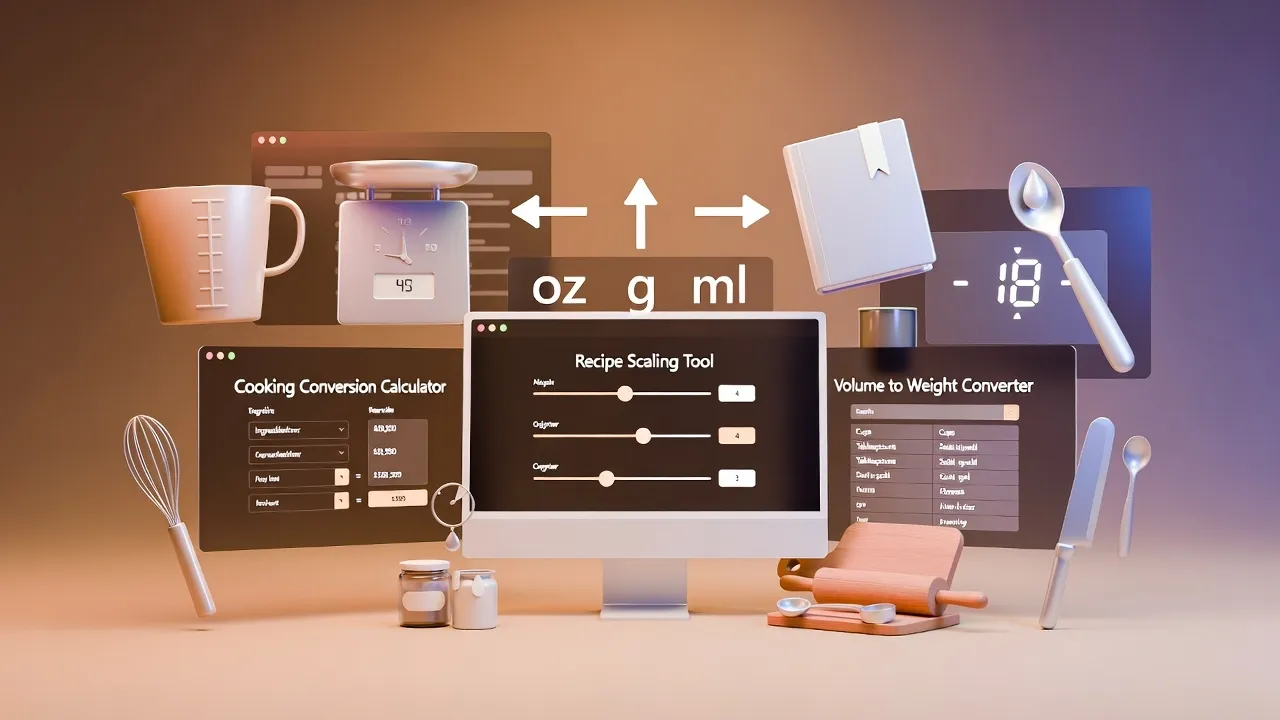
What Recipe Scaling Actually Is
Recipe scaling is the practice of producing a different number of servings from a recipe written for a specific number, while keeping the ratio of every ingredient to every other ingredient identical. The math is a single ratio applied uniformly. The hard part is knowing which quantities are ingredient ratios and which are environmental settings or chemistry rules that should not be touched. Salt, flour, milk, and stock are ratios — they scale. Oven temperature, pan size, proofing time, and (often) leavening agents are not pure ratios — they have their own rules.
This is the one idea that separates a recipe that scales cleanly from one that collapses when doubled. Once you internalize it, every other rule in this guide is a special case: the scaling factor is the math, the "do not scale" list is the discipline, and baker's percentages are the professional way to keep ratios exact across any batch size. The pillar unit converter tools guide covers the broader measurement vocabulary this guide assumes; here we focus tightly on the ratio logic of scaling itself.
The Scaling Factor Method
For ratio quantities, the entire method is one formula:
scaling_factor = target_servings / original_servings
new_amount     = original_amount * scaling_factor
That is it. The factor is dimensionless — a number, not a unit — and you apply it identically to every ingredient measured as a ratio. Worked example with verified arithmetic: a recipe serves 4 and you want to serve 6. The scaling factor is 6 ÷ 4 = 1.5. Two cups of flour become 2 × 1.5 = 3 cups. One teaspoon of salt becomes 1 × 1.5 = 1.5 teaspoons. Three tablespoons of olive oil become 3 × 1.5 = 4.5 tablespoons. The ratio of flour to salt to oil is preserved exactly, because every line is multiplied by the same 1.5.
Scaling down works the same way — the factor is just less than one. A 4-serving recipe scaled to 2 servings has a factor of 2 ÷ 4 = 0.5. One liter of stock becomes 0.5 L, two carrots become one, and 200 g of sugar becomes 100 g. The factor 0.5 is no different in kind from the factor 1.5; only its magnitude changes. A 4-serving recipe scaled to 1 serving uses the factor 1 ÷ 4 = 0.25, and a 4-serving recipe scaled to 10 uses 10 ÷ 4 = 2.5, so 200 g of sugar becomes 500 g and 0.5 teaspoon of salt becomes 1.25 teaspoons.
The factor works for any final serving count, including non-integer ones. A 6-serving recipe scaled to 5 uses 5 ÷ 6 ≈ 0.833, which is annoying by hand but trivial with a calculator. When the factor lands on a clean fraction — 1.5, 2, 0.5, 0.25, 3 — the math is easy enough to do in your head while you cook. When it does not, the calculators page has a free tool for it.
Scaling Down Without Breaking the Dish
Scaling down is easier on chemistry than scaling up — smaller batches cook faster, leaven more predictably, and reach internal temperature more quickly. The two things that bite you when halving a recipe are eggs and pan size. Half of one egg is not an egg: whisk the egg and use half by weight, which is about 25 g (one whole large egg is roughly 50 g, so half is 25 g). For odd-number scaling, a recipe that calls for 3 eggs often behaves better at two-thirds scale than at half, because halving 3 eggs means whisking and weighing out 1.5 eggs, which is awkward.
Pan size is the other half-recipe trap. The depth of the batter determines cooking time, and halving a recipe in the same pan halves the depth, which can overcook or dry out the dish. Use a smaller pan that holds the halved volume at roughly the same depth as the original — for a square or round pan, halving the volume means dropping one pan size (a 9-inch to a 7-inch, roughly). For a 2x scaling down, the tablespoon to cup converter and the ml to tablespoons converter handle the awkward half-measurements you'll land on.
Worked example, halving a soup: the recipe serves 8, you want 4. Factor is 4 ÷ 8 = 0.5. One liter of stock becomes 0.5 L, two carrots become one, 200 g of diced onion becomes 100 g, one teaspoon of salt becomes 0.5 teaspoon, and one bay leaf becomes — well, half a bay leaf, or one leaf pulled early. Oven temperature is irrelevant here because soup is cooked on the stovetop, but the same principle holds if you finish the soup in the oven: the dial does not move.
The "Do Not Scale" List
Some quantities are not ingredient ratios and must not be multiplied by the scaling factor. Treating them as ratios is the most common scaling mistake home cooks make.
Oven temperature — never scales
An oven set to 200°C delivers 200°C air whether one loaf or four loaves sit on the rack, because the thermostat holds air temperature constant. Doubling the recipe does not double the temperature — that would mean 400°C, which would incinerate the outside of the food before the inside warmed up. The oven temperature sets the heat-transfer driving force, not a per-portion quantity. What changes with batch size is cooking time, not temperature.
Cooking time — scales, but not linearly
Cooking time does change with batch size, but not in proportion to the scaling factor. A doubled cake does not bake in twice the original time. Heat transfer into the food depends on geometry, not just mass, and that geometry does not scale linearly. The structural framing is in the next section; the practical rule is to start checking doneness early, use a thermometer, and never multiply the original minutes by the scaling factor.
Baking powder and baking soda — not linear for large jumps
For small scaling (1.5x to 2x), most recipes tolerate scaling leavening linearly. For large jumps (3x and above), linear scaling over-leavens and the structure collapses, gets a metallic taste, or rises and falls. A common current practice is to scale leavening by roughly the square root of the batch factor — for a 4x recipe that gives about 2x the leavening instead of 4x — because the gas the leavening produces must escape through the batter's surface, and surface area scales slower than volume. Verify with your recipe source: baking powder scaling rules vary by recipe type, and some test kitchens prefer a flat 1.75x for any doubling rather than sqrt scaling. The structural reason for nonlinearity is real; the exact rule of thumb is recipe-dependent.
Salt and seasoning — linear, but taste-dependent
Salt scales linearly with the rest of the recipe in principle, but taste does not scale linearly with salt — larger batches often taste under-salted at the linear-scaled amount because salt perception depends on concentration at the tongue, not total quantity. A common practice is to scale salt by 0.75 to 1.0 times the linear amount and adjust to taste at the end. Strong spices like cayenne, clove, and cinnamon intensify disproportionately in large batches; start at about 1.5x when doubling and taste before adding more.
Yeast — linear with adjustments
Yeast scales more linearly than chemical leavening because it is a living organism that reproduces in the dough, but very large batches need longer proofing times because the dough mass retains more heat and the fermentation rate differs. For a 2x bread batch, doubling the yeast is fine; for a 5x batch, you may want to scale yeast by about 0.8x the linear amount and add proofing time.
Why 2× Recipe Doesn't Double Cooking Time
The honest framing here is structural, not numeric. Heat enters food through its surface and must diffuse to the center. When you scale a recipe by a factor of 2, the volume doubles but the surface area only grows by about 2^(2/3) ≈ 1.59, assuming the food keeps roughly the same shape. So the heat has 2x the mass to warm but only 1.59x the surface to enter through. That asymmetry — volume outpacing surface — is exactly why bigger batches take longer per unit of food, but not twice as long total.
Diffusion time scales with the square of the characteristic length, so doubling the thickness of a cake roughly quadruples the time to bring its center to temperature, but doubling the number of cakes (keeping thickness the same) barely changes the per-cake time at all. That is the crucial distinction: if your scaling keeps the food's depth constant (two cake layers in two pans instead of one), cooking time barely changes; if your scaling thickens the food (one bigger pan, deeper batter), cooking time grows fast — well above the scaling factor for the largest jumps.
The practical workflow: pick a target internal temperature, set a timer for the original recipe time, start checking doneness with a thermometer about 10 minutes early, and add time in 5-minute increments until the center hits target. Never multiply the original cooking time by the scaling factor — that would mean 4x the cook time for a 4x batch, which would absolutely overcook the outside before the inside finished.
Baker's Percentages: Professional Scaling for Bread
Baker's percentages are the bread baker's scaling system, and they are worth learning if you scale bread or pizza dough more than once a year. The rule is simple: flour is always 100%, and every other ingredient is expressed as a percentage of the flour's weight. A dough at 65% hydration means water is 65% of the flour weight. If the flour is 500 g, the water is 500 × 0.65 = 325 g. Salt at 2% is 500 × 0.02 = 10 g. Yeast at 1% is 500 × 0.01 = 5 g. The whole recipe is captured in four numbers — 100, 65, 2, 1 — and you can scale to any batch size by choosing a new flour weight and re-applying the same percentages.
# Baker's percentages: every ingredient is % of flour weight
# Recipe: flour 100%, water 65%, salt 2%, yeast 1%
# Original batch (500 g flour):
flour   = 500 g
water   = 500 * 0.65 = 325 g
salt    = 500 * 0.02 = 10 g
yeast   = 500 * 0.01 = 5 g
total   = 840 g

# Scaled to a 200% factor (double the flour, 1000 g):
flour   = 1000 g
water   = 1000 * 0.65 = 650 g
salt    = 1000 * 0.02 = 20 g
yeast   = 1000 * 0.01 = 10 g
total   = 1680 g
The "200% factor" in the heading above is bread-baker shorthand for doubling the flour weight — the original is treated as 100%, the scaled batch is 200% of it. The same percentages apply: water stays 65%, salt stays 2%, yeast stays 1%. You can target any flour weight — 250 g for a small loaf, 1.5 kg for a bake-sale batch, 5 kg for a commercial sheet pan — and the ratios stay exact. That is the entire point of baker's percentages: the recipe becomes a ratio set independent of batch size.
Two cautions. First, baker's percentages are always by weight, never volume — flour scooped by cup varies 25% in weight depending on how it was packed, which destroys the precision the system is built for. Weigh your flour. Second, hydration percentages above about 70% produce very slack doughs that need stretch-and-fold technique rather than kneading; the math is identical, but the handling changes. The weight converter handles unit conversions when your recipe is in ounces and your scale reads grams.
Volume-to-Weight Conversion for Scaling
Scaling by volume works for liquids with stable density — 1.5x a liter of milk is 1.5 L of milk, reliably. Scaling by volume for dry ingredients, especially flour, is the largest source of error in home scaling. One cup of all-purpose flour can weigh anywhere from about 110 g (spooned and leveled gently) to 140 g (dipped and packed), a 27% spread. When you then multiply by a 1.5x scaling factor, you may be applying the factor to 110 g or to 140 g — a 45 g difference in the final batter, which is more than enough to change a cake's texture from tender to tough.
The fix is to weigh. Common reference weights for cooking conversions (verify against your bag of flour, which can vary by brand):
| Ingredient | 1 cup (volume) | Approx. weight |
|---|---|---|
| All-purpose flour, spooned and leveled | 1 cup | ≈ 120 g |
| Granulated sugar | 1 cup | ≈ 200 g |
| Brown sugar, packed | 1 cup | ≈ 220 g |
| Butter | 1 cup (2 sticks) | ≈ 227 g |
| Water | 1 cup | ≈ 236 g (236 ml) |
| Cocoa powder, spooned | 1 cup | ≈ 85 g |
| Rolled oats | 1 cup | ≈ 90 g |
Once you have weights, the scaling factor is the only math left. Two cups of flour (240 g) scaled by 1.5 is 360 g, and 360 g is a measurement you can hit exactly on a digital scale. The grams to cups converter and ounces to grams converter handle one-off translations when a recipe is in one system and your scale is in another, and the ounces to grams cooking guide covers the cooking-specific conventions for those conversions in depth — read it alongside this guide if you scale recipes that mix volume and weight units.
Why Leavening Scales Differently
The structural reason leavening does not scale linearly with batch size is one of the more interesting bits of kitchen physics, and it is worth understanding rather than memorizing. Chemical leavening (baking powder, baking soda) produces carbon dioxide gas inside the batter. That gas forms bubbles, the bubbles rise to the surface, the surface sets, and you get lift. The amount of gas scales with the amount of leavening, which scales with the amount of batter — so at first glance, doubling the batter should double the leavening and produce double the gas, which fills double the volume. Linear scaling seems correct.
The catch is in the surface. Gas escapes through the top of the batter, and the top is a surface area. When you double the recipe and bake it in a larger pan, the batter volume is 2x but the surface area is only about 2^(2/3) ≈ 1.59x — surface scales slower than volume. So 2x the gas is trying to escape through only 1.59x the surface, which means more gas is trapped, which means more lift, which can over-expand the structure and collapse it. The same physics is why a 4x recipe really does over-leaven: 4x the gas against only 2.52x the surface.
The square-root rule of thumb falls out of this geometry, roughly. If gas volume scales linearly (with batch factor k) and surface area scales with k^(2/3), the gas-per-surface ratio scales as k^(1/3), which is much smaller than k for large k. To keep the lift roughly constant per unit of batter, you want the leavening to grow slower than the batter volume; the square root of k is one such choice, and it matches the intuition well for moderate jumps. For a 4x recipe, sqrt(4) = 2 — so use about 2x the baking powder, not 4x. For a 9x recipe, sqrt(9) = 3, so use about 3x the baking powder, not 9x. This is a rule of thumb, not a law: test kitchens vary, and some prefer flat multipliers (1.75x for any doubling) or empirical tables per recipe type. Verify with your recipe source for anything you intend to publish or sell.
Worked Examples: Bread, Cookies, Soup
Three end-to-end examples that exercise every rule in this guide. All arithmetic was verified with Python before publication.
Example 1 — Scaling bread with baker's percentages (factor 2.0)
Original bread recipe at 500 g flour, 65% hydration, 2% salt, 1% yeast (total dough 840 g). You want to bake for a bake sale, so you double the flour to 1000 g. The scaling factor on flour is 1000 ÷ 500 = 2.0, which is the "200% factor" in bread-baker shorthand. The other ingredients follow the same percentages:
- Flour: 1000 × 1.00 = 1000 g
- Water: 1000 × 0.65 = 650 g
- Salt: 1000 × 0.02 = 20 g
- Yeast: 1000 × 0.01 = 10 g
- Total dough: 1680 g
Oven temperature stays at the original — say 230°C for a crusty loaf — because the thermostat holds air temperature regardless of batch size. Proofing time will be a little longer for the larger dough mass because the bulk retains more heat and the fermentation front takes longer to even out, so plan to watch the dough, not the clock. Bake time will be a bit longer than the original loaf but well under 2x; use an internal temperature target (about 95°C for a fully baked loaf) and a thermometer.
Example 2 — Doubling cookies (factor 2.0)
Original chocolate chip cookie recipe makes 24 cookies. You want 48. Scaling factor is 48 ÷ 24 = 2.0. Apply it to every ingredient measured as a ratio:
- 250 g flour × 2 = 500 g
- 1 egg × 2 = 2 eggs
- 1 tsp vanilla × 2 = 2 tsp
- 0.5 tsp baking soda × 2 = 1 tsp (linear scaling is fine for a 2x jump)
- 200 g sugar × 2 = 400 g
Baking temperature stays at the original — typically 175°C — and per-cookie bake time barely changes because each cookie is the same size as before; you simply have more of them on more sheet pans. Total oven time across the batch will be longer because you must bake in multiple rounds, but each individual cookie's bake time is the original. The tablespoon to cup converter is handy if the doubled vanilla measurement lands on an awkward unit boundary.
Example 3 — Halving a soup (factor 0.5)
Original vegetable soup serves 8. You want 4. Scaling factor is 4 ÷ 8 = 0.5.
- 1 L stock × 0.5 = 0.5 L
- 2 carrots × 0.5 = 1 carrot
- 200 g onion × 0.5 = 100 g
- 1 tsp salt × 0.5 = 0.5 tsp (then taste — soups often want a touch more salt than half)
- 1 bay leaf × 0.5 = half a bay leaf, or one leaf pulled early
Soup is the most forgiving thing to scale because it is a stovetop braise with no leavening chemistry and no fixed structure to set. Heat is constant (the burner is on), doneness is by tasting, and the only structural quantity is the depth of liquid in the pot, which you can manage by choosing a smaller pot for the halved batch. Use the ml to tablespoons converter when the halved soup recipe lands on awkward volume units.
7 Common Recipe Scaling Mistakes (and the Fix for Each)
- Scaling oven temperature. Doubling a recipe and "doubling" a 180°C oven to 360°C is the fastest way to ruin dinner. Fix: oven temperature is an environmental setting, not a per-portion quantity. It never scales. Only cooking time changes, and not linearly.
- Multiplying cooking time by the scaling factor. A 2x cake at 2x the bake time is overcooked on the outside and raw in the middle. Fix: keep temperature constant, use a thermometer for doneness, and start checking about 10 minutes before the original time.
- Scaling baking powder linearly for large jumps. A 4x recipe with 4x the baking powder over-leavens and the structure collapses. Fix: for jumps above about 2x, scale leavening by roughly the square root of the batch factor — sqrt(4) = 2, not 4. Verify with your recipe source; test kitchens vary.
- Scaling salt to taste, not to ratio. Linear-scaled salt in a doubled batch often tastes under-salted because perception is concentration-dependent. Fix: scale by 0.75 to 1.0 times the linear amount and correct at the end, tasting with a clean spoon.
- Scaling by volume instead of weight for flour. A "cup" of flour varies 25% by weight depending on how it was scooped, so a 1.5x scaling by volume can compound that error. Fix: weigh the flour in grams. If the recipe is in cups, convert once to grams using a reference weight, then scale by the factor.
- Using the same pan for a scaled batch. A doubled cake in the original pan is a deeper cake that burns on the outside before the middle sets; a halved cake in the original pan is a thin layer that dries out. Fix: choose a pan that holds the scaled volume at roughly the original depth, or split across multiple pans of the original size.
- Forgetting that eggs do not halve cleanly. Half of one egg is not an egg. Fix: whisk the egg and use half by weight (about 25 g per half-egg from a 50 g large egg). For odd-number scaling, prefer two-thirds over one-half when the recipe has an odd number of eggs.
Every one of these mistakes has the same root cause: treating a quantity as a ratio when it is not, or treating a non-ratio as a ratio. The scaling factor method covers the ratios; the rest of this guide covers the discipline.
Frequently Asked Questions
Related Articles
Unit Converter Tools Guide (Pillar)
The cluster pillar: every unit conversion tool on the site, organized for cooking, math, and engineering workflows.
Celsius & Fahrenheit Converter Guide
Oven temperature math across unit systems — paired with this guide because oven temperature is the one quantity you must never scale.
How to Convert Measurements (Unit Converter Guide)
The general measurement-conversion reference you reach for when a scaled recipe lands on a unit your scale does not display.
How to Convert Measurements
Step-by-step measurement conversions for volume, weight, and temperature — the practical companion to ratio scaling.
Measurement Precision Guide
Significant figures and rounding for cooking and baking math — relevant when a 1.5x scaling factor produces 0.541 teaspoons.
Military Time Converter Guide
Time-format conversion for cooking timers and proofing schedules across 12-hour and 24-hour clocks.
Ounces & Grams Cooking Guide
The sibling guide to this one — read it for the cooking-specific volume and weight conventions that make scaling by weight possible.
Conclusion: Scaling Is Ratio Math, Not Guessing
Recipe scaling is one formula — new_amount = original_amount × (target_servings ÷ original_servings) — and one discipline, which is knowing what not to scale. Oven temperature never scales, cooking time scales sub-linearly and only matters when the food's depth changes, leavening scales by the square root of the batch factor for large jumps, and salt and seasoning scale linearly but taste-dependently. Baker's percentages take all of this to professional precision for bread: express everything as a percentage of flour weight, then choose a new flour weight and the recipe adapts exactly. Weight, not volume, is the measurement system that makes the math honest — convert once, scale forever.
When you are ready to apply this, the converters hub has every unit-conversion tool on the site, the calculators page handles the scaling-factor math for awkward fractions, and the broader cluster starts at the unit converter tools guide. More cooking, measurement, and math guides are catalogued on the NoCostTools blog.