JWT Decoder Security Guide: Complete Token Analysis & Debugging for Developers 2025
Master JWT security analysis with our comprehensive guide. Learn token structure, security vulnerabilities, debugging techniques, and professional best practices for secure authentication system implementation and analysis.
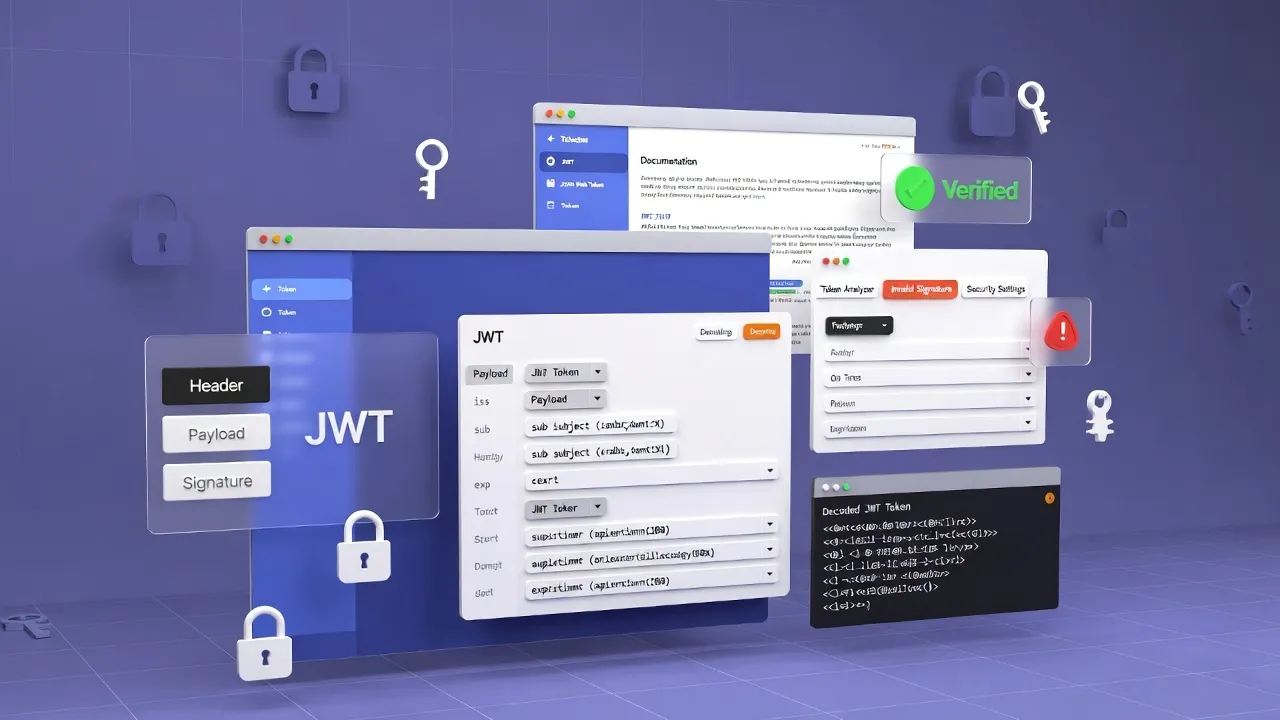
Understanding JWT Security in Modern Web Development
JSON Web Tokens (JWTs) are the backbone of modern authentication systems, but they're also a common source of security vulnerabilities. Proper JWT analysis and debugging are essential for secure application development. In 2025, with 78% of data breaches involving weak authentication, understanding JWT security is critical for developers and security professionals.
Our JWT Decoder provides secure, client-side token analysis that helps developers understand, debug, and secure their JWT implementations without compromising sensitive data.
JWT Structure and Components Deep Dive
Understanding JWT structure is fundamental to proper security analysis and debugging:
JWT Three-Part Structure:
1. Header (Algorithm and Token Type)
{
  "alg": "HS256",
  "typ": "JWT"
}- Algorithm (alg): Specifies signing algorithm (HS256, RS256, ES256)
- Type (typ): Token type, always "JWT"
- Security note: Header is Base64 encoded, not encrypted
2. Payload (Claims and Data)
{
  "sub": "1234567890",
  "name": "John Doe",
  "iat": 1516239022,
  "exp": 1516242622
}- Standard claims: iss, sub, aud, exp, nbf, iat, jti
- Custom claims: Application-specific data
- Security note: Payload is visible to anyone with the token
3. Signature (Verification)
HMACSHA256(
  base64UrlEncode(header) + "." +
  base64UrlEncode(payload),
  secret)
Standard JWT Claims
- iss (issuer): Who created the token
- sub (subject): User identifier
- aud (audience): Intended recipient
- exp (expiration): Token expiry time
- iat (issued at): Creation timestamp
Security Considerations
- Never store sensitive data in payload
- Always validate expiration times
- Verify signature before trusting claims
- Use strong, unique signing keys
- Implement proper key rotation
JWT Algorithms and Security Implications
Different JWT algorithms have distinct security characteristics and use cases:
| Algorithm | Type | Key Management | Performance | Security Level | Best Use Cases |
|---|---|---|---|---|---|
| HS256 | HMAC + SHA256 | Symmetric (shared secret) | Fast | Good (if key secured) | Single service, internal APIs |
| RS256 | RSA + SHA256 | Asymmetric (public/private) | Slower | High | Microservices, public APIs |
| ES256 | ECDSA + SHA256 | Asymmetric (smaller keys) | Fast | Very High | Mobile apps, IoT devices |
| PS256 | RSA-PSS + SHA256 | Asymmetric (enhanced) | Slower | Very High | High-security applications |
| none | No signature | N/A | Fastest | None | Never use in production |
Algorithm Security Best Practices
Secure Practices
- Whitelist algorithms: Only accept expected algorithms
- Strong keys: Use cryptographically secure key generation
- Key rotation: Regularly rotate signing keys
- Algorithm consistency: Don't allow algorithm switching
Common Vulnerabilities
- None algorithm: Accepting unsigned tokens
- Algorithm confusion: HS256/RS256 key mix-up
- Weak keys: Short or predictable secrets
- Key exposure: Hardcoded or leaked keys
Professional JWT Debugging Techniques
Effective JWT debugging requires systematic analysis of each token component:
Step-by-Step Debugging Process
- Token Format Validation: Ensure three parts separated by dots
- Base64 Decoding: Decode header and payload (signature stays encoded)
- JSON Structure Analysis: Validate JSON syntax in header/payload
- Claims Inspection: Check standard and custom claims
- Timestamp Validation: Verify exp, iat, nbf claims
- Signature Verification: Validate against known key
Common JWT Issues and Solutions
| Issue | Symptoms | Debugging Steps | Solution |
|---|---|---|---|
| Token Expired | 401 Unauthorized errors | Check exp claim vs current time | Refresh token or extend expiration |
| Invalid Signature | Authentication failures | Verify signing key and algorithm | Use correct key or fix algorithm |
| Malformed Token | Parsing errors | Check Base64 encoding and structure | Regenerate token with correct format |
| Missing Claims | Authorization failures | Inspect payload for required claims | Include necessary claims in token |
| Clock Skew | Intermittent failures | Compare iat/exp with server time | Implement clock skew tolerance |
Advanced Debugging with JWT Decoder
Professional Debugging Features
Our JWT Decoder provides comprehensive token analysis including header inspection, payload examination, timestamp validation, and signature verification status - all processed client-side for security.
JWT Security Vulnerability Assessment
Regular security assessment of JWT implementations prevents common attack vectors:
Critical Vulnerabilities to Check
Algorithm Attacks
- None algorithm: Accept unsigned tokens
- Algorithm confusion: RS256/HS256 mix-up
- Weak algorithms: Deprecated signing methods
- Algorithm downgrade: Force weaker algorithms
Implementation Flaws
- Missing validation: Skip signature verification
- Improper expiration: Ignore exp claims
- Key management: Weak or exposed keys
- Information disclosure: Sensitive data in payload
Business Logic Issues
- Privilege escalation: Modifying role claims
- Session management: No token revocation
- Replay attacks: Missing jti claims
- Audience validation: Wrong recipient acceptance
Security Assessment Checklist
- ✅ Algorithm whitelist: Only accept approved algorithms
- ✅ Key strength: Use cryptographically strong keys (256+ bits for HS256)
- ✅ Expiration validation: Always check exp claim with clock skew tolerance
- ✅ Signature verification: Verify signature before trusting any claims
- ✅ Issuer validation: Verify iss claim matches expected issuer
- ✅ Audience validation: Check aud claim for intended recipient
- ✅ Payload sanitization: Never include sensitive data in payload
- ✅ Key rotation: Implement regular key rotation procedures
JWT Best Practices for Secure Implementation
Follow these professional practices for secure JWT implementation:
Token Lifecycle Management
Token Generation
- Short expiration: 15-60 minutes for access tokens
- Secure algorithms: Use RS256 or ES256 for production
- Minimal payload: Include only necessary claims
- Unique identifiers: Use jti for token tracking
Token Validation
- Signature first: Verify signature before reading claims
- Expiration check: Reject expired tokens immediately
- Issuer verification: Validate token source
- Audience check: Ensure token is for your service
Production Security Configuration
| Security Aspect | Development | Staging | Production | Notes |
|---|---|---|---|---|
| Signing Algorithm | HS256 (testing) | RS256 | RS256/ES256 | Never use 'none' algorithm |
| Token Expiration | 24 hours | 1 hour | 15-60 minutes | Use refresh tokens for longer sessions |
| Key Management | Static keys | Rotated keys | Automated rotation | Rotate keys every 30-90 days |
| Debug Information | Verbose errors | Limited details | Generic errors | Prevent information leakage |
| Token Storage | LocalStorage OK | HttpOnly cookies | HttpOnly + Secure | Prevent XSS token theft |
Security Implementation Tips
- Use refresh tokens: Implement short-lived access tokens with longer refresh tokens
- Implement token blacklisting: Maintain revoked token list for immediate invalidation
- Monitor token usage: Log and alert on suspicious token activity
- Rate limiting: Prevent brute force attacks on token endpoints
JWT Testing and Quality Assurance
Comprehensive testing ensures JWT security across all scenarios:
Security Test Cases
Algorithm Security Tests:
- Test rejection of 'none' algorithm tokens
- Verify algorithm confusion prevention (HS256/RS256 switch)
- Test signature verification with wrong keys
- Validate strong key requirements enforcement
Token Validation Tests:
- Expired token rejection
- Future-dated token handling (nbf claim)
- Missing required claims validation
- Malformed token structure handling
Claims Validation Tests:
- Issuer (iss) claim verification
- Audience (aud) claim validation
- Subject (sub) claim consistency
- Custom claims integrity
Automated Testing Tools
Development Tools
- Unit tests: Test JWT library functions
- Integration tests: End-to-end authentication flows
- Security tests: Vulnerability scanning
- Performance tests: Token generation/validation speed
Security Analysis
- Static analysis: Code review for JWT vulnerabilities
- Dynamic testing: Runtime security testing
- Penetration testing: Professional security assessment
- Compliance audits: Regulatory requirement validation
Frequently Asked Questions
Ready to Analyze Your JWTs?
Use our secure JWT decoder to analyze token structure, validate claims, and debug authentication issues. All processing happens client-side for maximum security.
Decode JWT NowRelated Security Tools
Table of Contents
Popular Security Guides
LLMS.txt Documentation Guide AUTHENTICATION
Password Security Guide WEB SECURITY
API Security Guide